History is often remembered through major events such as wars, revolutions, and political movements that are widely taught in schools. However, many lesser-known historical moments have also played a crucial role in shaping the world we live in today. These events may not always appear in textbooks, but their impact on politics, science, culture, and society has been significant. Exploring these hidden moments of history allows us to better understand how small events can lead to major global changes.
The Eruption That Caused “The Year Without a Summer”
In 1815, Indonesia experienced a massive volcanic eruption when Mount Tambora erupted with extraordinary force. While volcanic eruptions are not uncommon, this particular event had global consequences that few people initially understood.
The eruption released enormous amounts of ash and gases into the atmosphere, blocking sunlight and affecting the global climate. As a result, the year 1816 became known as “The Year Without a Summer.” Temperatures dropped across Europe and North America, crops failed, and food shortages became widespread. Many communities experienced famine and economic hardship.
This climatic disaster also influenced migration patterns and agricultural development in several countries. Scientists later studied this event to better understand how volcanic activity can influence global climate systems.
The Great Emu War in Australia
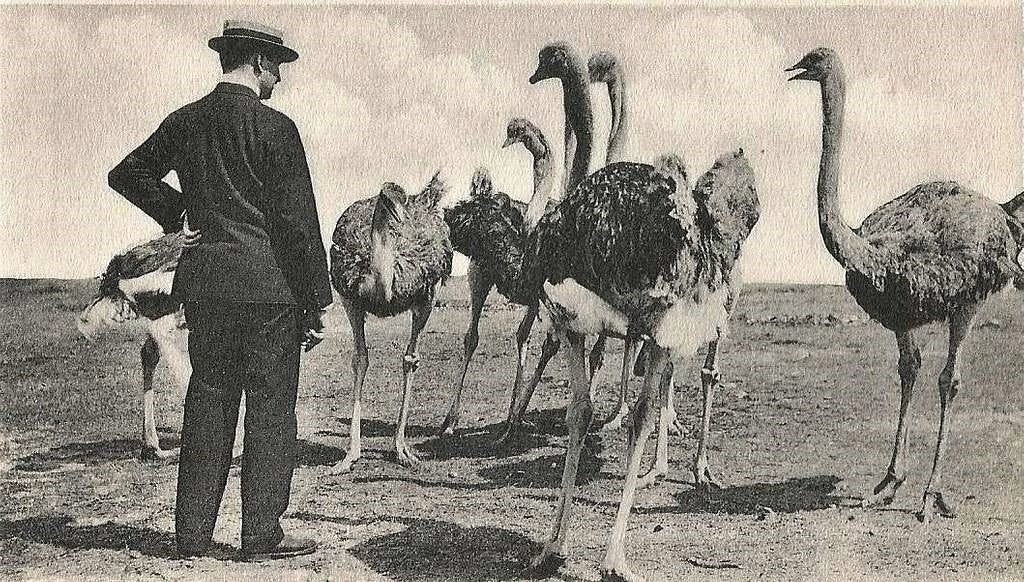
One of the most unusual historical conflicts occurred in Australia during the early 1930s. Farmers in Western Australia were struggling with a large emu population that was destroying crops and farmland. In response, the government launched a military operation to control the bird population.
The event became known as the Emu War, where soldiers attempted to reduce the emu population using machine guns. Surprisingly, the birds proved difficult to control due to their speed and ability to scatter quickly.
Although the operation was not entirely successful, the event highlighted challenges in managing wildlife and agricultural sustainability. It also became one of the most unusual military operations in modern history and remains a fascinating example of how governments sometimes face unexpected challenges.
The Accidental Discovery That Changed Medicine
In 1928, a simple laboratory accident led to one of the most important medical discoveries in history. Scottish scientist Alexander Fleming noticed that a mold growing on a petri dish had killed nearby bacteria.
This accidental observation led to the discovery of Penicillin, the world’s first widely used antibiotic. Before antibiotics, many common infections were deadly because there were no effective treatments.
Penicillin revolutionized modern medicine by allowing doctors to treat bacterial infections that once caused millions of deaths. It paved the way for the development of additional antibiotics and modern pharmaceutical research, saving countless lives worldwide.
The Tunguska Explosion
In 1908, a mysterious explosion occurred in a remote region of Siberia near the Tunguska River. The explosion flattened millions of trees across a vast area of forest but left no visible crater.
Scientists later determined that the event was most likely caused by a large meteor or asteroid exploding in the atmosphere before reaching the ground. The Tunguska Event remains one of the most powerful explosions in recorded history.
Although it occurred in a sparsely populated region, the event raised awareness of the potential dangers posed by near-Earth objects. Today, scientists and space agencies monitor asteroids more carefully to prevent possible future impacts.
The Boston Molasses Disaster
Not all historical disasters involve natural forces or warfare. In 1919, a massive industrial accident occurred in Boston when a large molasses storage tank suddenly burst.
The Great Molasses Flood sent a wave of sticky syrup rushing through the streets at surprising speed. Buildings were damaged, vehicles were overturned, and several people lost their lives.
This unusual disaster led to important changes in building regulations and industrial safety standards in the United States. Engineers and government authorities began implementing stricter inspections for large storage tanks and infrastructure projects.
How Small Events Can Shape Global History
Many historical turning points begin with events that seem small or isolated at the time. A scientific discovery in a laboratory, an environmental disaster, or an unexpected accident can influence global policies, technological advancements, and social development.
These lesser-known moments remind us that history is shaped not only by famous leaders or major wars. Ordinary circumstances, scientific curiosity, and unexpected incidents often lead to breakthroughs that transform societies.
Studying these events also encourages critical thinking and curiosity about the past. It shows that even the smallest discoveries or challenges can create ripple effects that extend far beyond their original context.
Conclusion
History is full of surprising and little-known events that have changed the course of human development. From the eruption of Mount Tambora and the unusual Emu War to the accidental discovery of penicillin and the mysterious Tunguska explosion, these moments demonstrate how unexpected events can shape the world.
Understanding these lesser-known historical events provides a deeper appreciation for the complexity of global history. They remind us that major transformations often begin with small moments that no one initially realizes will change the future.
Related Posts