
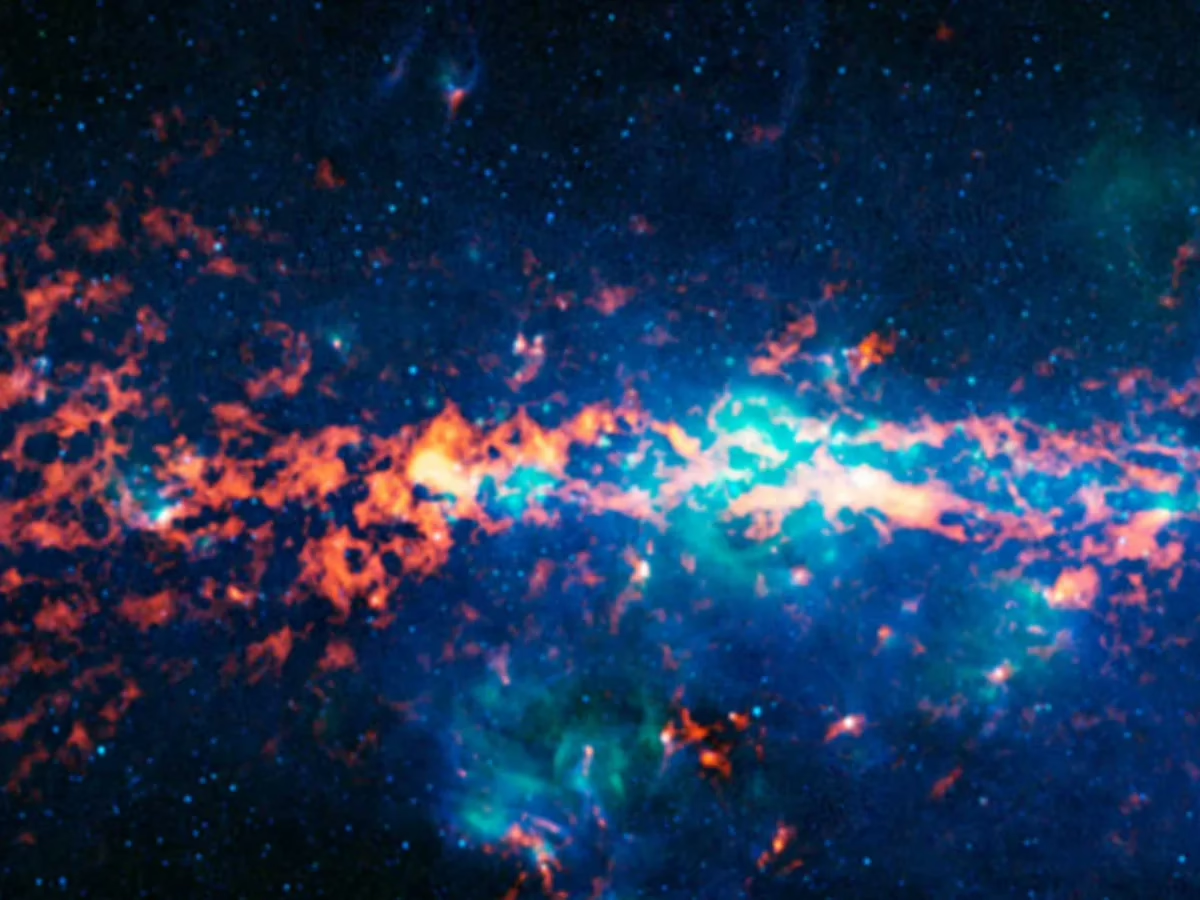
Space is often imagined as cold, empty, and lifeless. But in reality, it’s filled with vast clouds of gas and dust containing complex chemicals—some of them surprisingly familiar. One of the strangest discoveries ever made by astronomers is that there are clouds of alcohol floating in space.
Deep within our galaxy lies a massive region known as Sagittarius B2, a giant molecular cloud that contains enormous quantities of ethanol, the same type of alcohol found in beer and other alcoholic drinks. In fact, scientists estimate there’s enough ethanol there to theoretically produce trillions of bottles of beer.
As bizarre as it sounds, this discovery is very real—and incredibly important for understanding the origins of chemistry in the universe.
What Is Sagittarius B2?
Sagittarius B2 (often shortened to Sgr B2) is one of the largest and most complex molecular clouds in the Milky Way galaxy. It’s located near the galactic center, about 25,000 light-years from Earth.
This massive cloud spans hundreds of light-years and contains:
- Dense gas and dust
- Regions where new stars are forming
- A rich mix of chemical compounds
Molecular clouds like Sagittarius B2 are cosmic nurseries, places where stars and planetary systems begin their lives.
How Did Scientists Discover Alcohol in Space?
Astronomers detect chemicals in space using radio telescopes. Every molecule emits and absorbs radiation at specific frequencies, creating a unique “chemical fingerprint.”
When scientists pointed radio telescopes toward Sagittarius B2, they detected signatures of ethanol (C₂H₅OH) drifting within the cloud. This wasn’t a tiny trace—it was an enormous amount spread across an unimaginably large region.
Over time, researchers also identified other complex organic molecules in the same cloud, including:
- Methanol
- Formic acid
- Acetone
- Even simple sugars
These findings revealed that space chemistry is far more complex than once believed.
Trillions of Bottles of Beer — What Does That Really Mean?
The idea that Sagittarius B2 contains enough alcohol to make trillions of bottles of beer is meant to help us grasp the scale of the discovery. Of course, there’s no brewery floating in space.
The ethanol in Sagittarius B2 is:
- Extremely diluted
- Spread across vast distances
- Mixed with other gases and dust
If you tried to “drink” it, you’d be disappointed—space alcohol is nothing like liquid beer. Still, when scientists calculate the total amount of ethanol present, the number is so large that comparisons like “trillions of bottles” become the easiest way to explain it.
Why Alcohol Exists in Space at All
Ethanol doesn’t form the same way in space as it does on Earth. In molecular clouds, alcohol molecules are created through chemical reactions on icy dust grains.
Here’s how it works:
- Dust particles become coated with thin layers of ice
- Atoms and simple molecules land on these icy surfaces
- Low temperatures and radiation trigger chemical reactions
- Complex molecules, including ethanol, are formed
When nearby stars heat the region, these molecules are released into space as gas, creating massive chemical clouds.
What This Means for Life in the Universe
The discovery of ethanol and other organic molecules in Sagittarius B2 has huge implications for astrobiology.
Ethanol itself isn’t a sign of life, but it is an organic molecule, meaning it contains carbon—a key ingredient for life as we know it. The fact that complex organic chemistry happens naturally in space suggests that the building blocks of life are widespread across the galaxy.
This supports the idea that:
- Organic molecules can form before planets exist
- Young planets may inherit these chemicals
- Life-friendly chemistry could be common in the universe
In other words, the ingredients for life may be scattered everywhere—even in the dark spaces between stars.
A Universe Far Stranger Than Fiction
Alcohol clouds floating in space sound like a joke or a sci-fi fantasy, but they highlight an important truth: the universe is incredibly creative with chemistry.
Space isn’t just rocks, stars, and empty voids. It’s a vast chemical laboratory where molecules form, break apart, and recombine over millions of years. Some of these molecules are familiar to us, while others are entirely alien.
Sagittarius B2 stands as one of the clearest examples of this cosmic chemistry at work.
Could Humans Ever Use Space Alcohol?
Practically speaking, no. The ethanol in Sagittarius B2 is far too spread out and far too distant to ever be collected. Traveling tens of thousands of light-years for diluted alcohol is wildly impractical.
But the value of this discovery isn’t economic—it’s scientific. Understanding how complex molecules form in space helps researchers piece together the story of how planets, atmospheres, and possibly life itself come into existence.
Final Thoughts
The idea that there are clouds of alcohol drifting through space reshapes how we think about the cosmos. Sagittarius B2 shows us that even in the cold darkness between stars, chemistry is alive and active.
Enough ethanol to make trillions of bottles of beer may never quench anyone’s thirst, but it fuels something far more important: our curiosity about the universe. In a galaxy full of mysteries, even alcohol can become a clue to understanding where we come from—and how strange the cosmos truly is.
Related Posts