
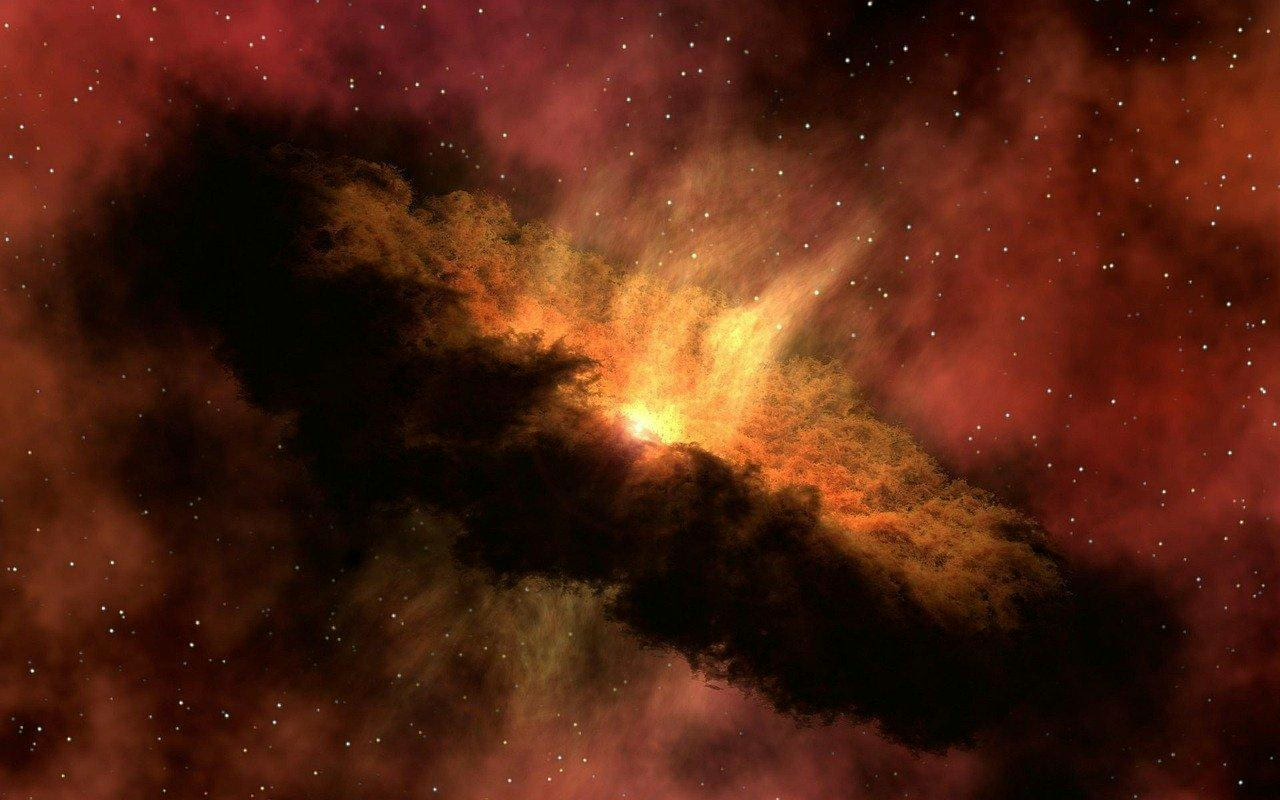
If you’ve ever watched a space movie, you’ve probably heard it: massive explosions roaring through the cosmos, laser blasts screaming across the void, and spacecraft engines rumbling dramatically. It all sounds thrilling—but there’s one big problem. In real space, none of that noise would exist.
Space is completely silent. No booms. No blasts. No echoes.
This surprising fact isn’t just trivia—it’s rooted in the fundamental laws of physics. Understanding why space is silent reveals just how strange and fascinating the universe really is.
Why Sound Needs Air to Exist
To understand why space is silent, we first need to understand how sound works.
Sound is not a thing you can see or touch—it’s a vibration. When something explodes, speaks, or crashes, it creates vibrations that travel through a medium such as air, water, or solid objects. These vibrations move as sound waves until they reach your ears.
On Earth, sound travels easily through the air molecules around us. When something makes noise, it pushes molecules, which bump into one another, creating a chain reaction that carries sound over distances.
But here’s the catch: without a medium, sound cannot travel at all.
Space Is a Vacuum—and Vacuums Kill Sound
Outer space is almost entirely a vacuum, meaning it has extremely few particles—no air, no gas, no molecules close enough to carry vibrations.
Because of this:
- Sound waves have nothing to travel through
- Explosions create light and energy, but not sound
- Even the most violent cosmic events happen in total silence
If you were floating next to an exploding star (and somehow survived), you would see the explosion in dazzling detail—but you wouldn’t hear a thing.
What About the Sun and Other Stars?
The Sun constantly releases massive bursts of energy, solar flares, and shockwaves powerful enough to disrupt satellites and power grids on Earth. Yet, despite its intensity, the Sun is silent in space.
Inside stars and planets, sound waves do exist because there is matter for vibrations to travel through. Scientists can even “listen” to stars by translating internal vibrations into data. However, once those vibrations reach the vacuum of space, they stop completely.
So while stars may “roar” internally, the universe outside remains eerily quiet.
Why Explosions in Space Movies Are Wrong
Hollywood knows space is silent—but silence doesn’t sell tickets.
Movie explosions are often exaggerated, with thunderous sound effects, to make scenes more dramatic and emotionally intense. In reality:
- A spaceship exploding would produce no sound outside the craft
- Laser battles would be visually spectacular but completely silent
- Engines would not rumble in open space
Some filmmakers have tried to be scientifically accurate. Movies like 2001: A Space Odyssey and parts of Gravity used silence to portray space more realistically, creating a haunting and immersive experience.
Ironically, silence often makes space feel even more terrifying.
Can Astronauts Hear Anything in Space?
Astronauts don’t hear sound through open space, but that doesn’t mean their world is silent.
Inside spacecraft:
- Air allows sound to travel normally
- Astronauts can hear voices, alarms, and machinery
- Vibrations can travel through solid materials, like metal
If two astronauts touched their helmets, vibrations could travel through the material and allow some sound to pass through. Similarly, astronauts can “feel” vibrations through their suits or equipment—but they still can’t hear sound through space itself.
The Psychological Impact of Cosmic Silence
The silence of space isn’t just a scientific detail—it has a strong psychological effect.
Astronauts often describe space as:
- Isolated
- Unforgiving
- Profoundly quiet
Without sound, even danger feels distant. A malfunction might appear visually dramatic but arrive without warning noise. This eerie stillness reminds us how fragile human life is outside Earth’s protective atmosphere.
Silence, in space, isn’t peaceful—it’s absolute.
Can Sound Ever Travel in Space?
Under very specific conditions, yes—but not in the way you’d expect.
Some regions of space contain thin clouds of gas. While sound could technically travel through these gases, the particles are so far apart that the sound would be incredibly faint and slow, well below what human ears can detect.
Scientists sometimes convert electromagnetic waves, plasma vibrations, or radio signals into sound for research purposes. These “space sounds” you hear online are data translated into audio, not actual sound traveling through space.
What the Silence of Space Teaches Us
The fact that space is silent highlights how unique Earth truly is. Our atmosphere doesn’t just give us oxygen—it gives us sound, communication, music, and connection.
Beyond Earth, the universe operates by different rules:
- Light dominates instead of sound
- Motion happens without noise
- Violence unfolds in silence
It’s a powerful reminder that the universe doesn’t exist for our comfort or expectations.
Final Thoughts
So the next time a movie theater shakes from a massive space explosion, remember the truth: real space is silent beyond imagination. No matter how violent or beautiful the event, the universe watches it unfold without a sound.
And somehow, that silence makes space even more mysterious—and far more humbling—than any Hollywood explosion ever could.
Related Posts