
The ocean is filled with objects that don’t belong—drifting debris, lost equipment, forgotten wreckage. Most of the time, these things are explained quickly and quietly. But every so often, something appears on the water that defies easy explanation.
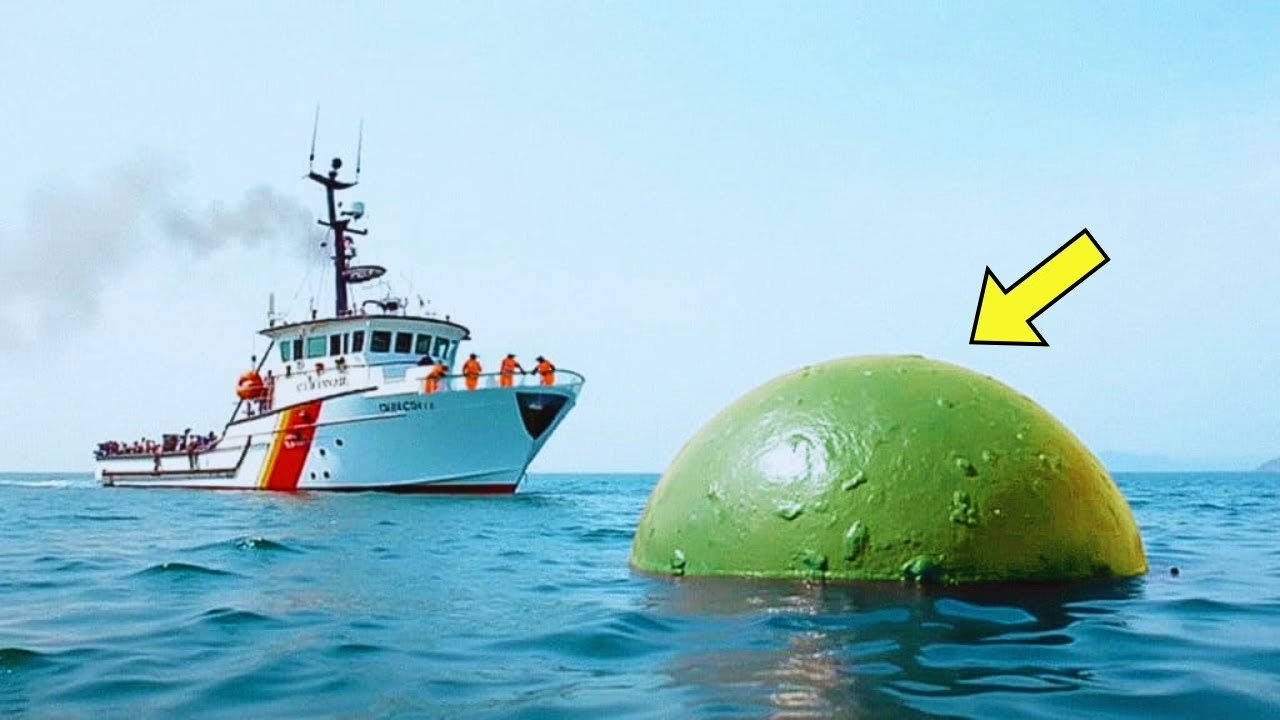
When local fishermen began calling the Coast Guard with reports of a massive floating sphere far from shore, officials initially assumed it was just another navigational buoy that had broken loose. But as more calls came in, all describing the exact same thing, concern began to grow.
This was no ordinary buoy.
And by the time the Coast Guard reached it, everyone involved would realize they were dealing with something far stranger than anyone had imagined.
A Pattern Emerges at Sea
It was just after dawn when the first call came in.
A fisherman, already several hours into his day, reported seeing “something big and round” floating roughly ten miles offshore. He described it as metallic, smooth, and unnaturally large—far bigger than any buoy he had ever seen.
At first, dispatch logged it as debris.
Then another call came in.
Then another.
Each fisherman described the same object. A perfect sphere. Dark in color. Floating low in the water. Completely motionless despite the gentle waves.
Most unsettling of all, none of them had seen it there before.
Too Many Reports to Ignore
Within an hour, the Coast Guard’s local office had received more than a dozen calls. All from different vessels. All from different locations. But all pointing to the same coordinates.
That was when the situation changed.
Multiple consistent reports meant one thing: this object was real, and it needed to be checked.
Officials escalated the matter to Captain Arnold Wilkins, a seasoned Coast Guard officer with more than twenty years of experience. Wilkins had seen his fair share of unusual situations at sea, but even he found the descriptions unsettling.
A floating sphere?
Ten miles from shore?
No identification markings?
No known origin?
It didn’t sit right.
Captain Wilkins Takes Command
Captain Wilkins gathered his six-person crew at the dock shortly after receiving the briefing. The mood was serious but calm. Missions like this weren’t uncommon—but they were rarely this vague.
“All we know,” Wilkins told his team, “is that there’s a large object floating offshore. No signals. No movement. No explanation.”
He paused before adding, “That means we approach with caution.”
The team nodded.
They boarded their vessel and set off, cutting cleanly through calm waters under clear skies. The weather was stable. Visibility was excellent. Perfect conditions for an investigation.
Yet no one aboard could shake the feeling that something was off.
First Contact
It took just under an hour to reach the reported location.
As the Coast Guard vessel slowed, eyes scanned the horizon.
Then someone spotted it.
“There,” one crew member said quietly.
At first, it looked unreal—like a trick of the light. But as they drew closer, there was no denying it.
A massive sphere floated on the water’s surface.
Perfectly round.
Perfectly still.
An Object That Didn’t Belong
The sphere was enormous—easily the size of a small car. Its surface was smooth and metallic, dark blue in color, with no visible seams, rivets, or markings. No rust. No damage.
It didn’t resemble any buoy, submarine equipment, or marine device the crew had ever seen.
It bobbed gently with the waves but didn’t drift.
That alone was strange.
Most floating objects moved with the current. This one didn’t.
“It’s like it’s anchored,” someone muttered.
But sonar scans showed nothing beneath it.
Nothing connecting it to the seafloor.
It was simply… there.
No Signals, No Identification
Captain Wilkins ordered a full scan.
Radar showed nothing unusual.
There were no radio signals.
No distress beacons.
No transponders.
The sphere was completely silent.
“That rules out standard equipment,” Wilkins said.
The crew circled the object slowly, documenting everything. Up close, the surface looked almost manufactured—but unlike anything commercially known. It reflected sunlight in an odd way, almost absorbing it rather than shining.
Then one crew member noticed something subtle.
A faint outline.
A circular indentation, barely visible, running along one side.
“Captain,” he said, “this might open.”
The Decision to Investigate Further
Protocol required caution. Unknown floating objects could be dangerous—explosive devices, hazardous materials, or experimental equipment. But nothing about the sphere suggested immediate danger.
Still, Wilkins didn’t take chances.
He contacted headquarters and reported the situation in detail. After reviewing the information, officials authorized a closer inspection—but not opening the object unless absolutely necessary.
The crew prepared safety gear.
A small team approached the sphere using a rigid inflatable boat.
Up close, it felt even more unnatural.
The water around it was calm. Almost too calm.
Something Beneath the Surface
As the inflatable drifted closer, the crew noticed a faint vibration.
Not a sound.
A feeling.
Like standing near a running generator.
“This thing’s active,” one crew member said.
They placed a hand against the surface.
It was cool.
Too cool.
Despite sitting in direct sunlight for who knew how long.
That was when the sphere reacted.
The Sphere Responds
Without warning, the faint indentation along the surface began to glow.
A soft white light traced the outline of a circular panel.
The crew froze.
No one touched anything.
The glow intensified slightly, then stopped.
“It’s reacting to us,” someone whispered.
Captain Wilkins, watching from the main vessel, immediately ordered the team to pull back.
They did so slowly, never taking their eyes off the object.
The glow faded.
The sphere returned to its silent, motionless state.
Escalation to Federal Authorities
This was no longer a routine Coast Guard matter.
Wilkins reported everything—the movement, the glow, the vibration.
Within minutes, the response from headquarters was clear: maintain a perimeter and await further instructions.
Other agencies were notified.
The area was restricted.
Civilian vessels were redirected.
Whatever the sphere was, it had just become a high-priority investigation.
Theories Begin to Spread
As word of the operation spread internally, speculation followed.
Some suggested advanced oceanographic equipment—though no research group claimed ownership.
Others wondered if it was experimental military technology—but there were no records.
A few quietly voiced thoughts they didn’t want to say out loud.
Could it be something else entirely?
No one knew.
And that uncertainty made it worse.
Nightfall at Sea
As evening approached, the sphere remained unchanged.
It didn’t sink.
It didn’t move.
It didn’t react again.
The Coast Guard maintained watch throughout the night, floodlights illuminating the object from a distance. Drones were deployed to monitor it continuously.
Nothing happened.
Yet no one slept easily.
The Morning Revelation
At first light, something new appeared.
Condensation.
The surface of the sphere had developed a fine layer of moisture—despite the surrounding air being dry.
Then the glow returned.
This time, stronger.
The circular outline expanded, slowly separating from the rest of the sphere.
“It’s opening,” someone said.
The Coast Guard vessel pulled back to a safe distance.
The crew watched in stunned silence.
What Was Inside
The panel lifted smoothly, revealing an interior chamber.
It was hollow.
Lined with unfamiliar materials.
But what caught everyone’s attention was the structure inside.
A framework.
Seats.
Control panels.
This wasn’t debris.
This wasn’t equipment.
This was a vessel.
And it was empty.
A Vessel Without a Crew
The interior showed clear signs of use. Worn surfaces. Handholds. Displays dark but intact. No damage. No signs of struggle.
But no occupants.
No identification.
No language markings.
Just technology that didn’t match anything known.
One officer summed it up simply:
“Someone was here.”
The Aftermath
The sphere was secured and transported under heavy guard to a classified facility. The operation was sealed. Official statements described the object as “an unidentified maritime device under investigation.”
No further details were released.
Captain Wilkins and his crew were instructed not to speak publicly.
But the fishermen remembered what they saw.
And rumors began to spread.
Questions Without Answers
To this day, no official explanation has been provided.
Who built the sphere?
Why was it floating offshore?
How long had it been there?
And most unsettling of all—
Where did its occupants go?
A Moment That Changed Everything
For Captain Arnold Wilkins, the mission would remain unforgettable.
In a career defined by storms, rescues, and long nights at sea, nothing compared to the moment that sphere opened.
Because the ocean had always been unpredictable.
But this?
This was something else entirely.
Related Posts