
The ocean has always kept secrets better than any place on Earth. Miles beneath its surface lie forgotten ships, lost cargo, and mysteries that have slept undisturbed for decades. But every once in a while, something rises from the depths that was never meant to be found.
This was one of those times.
What began as a routine research mission would soon turn into an operation involving the Coast Guard, marine engineers, and federal investigators. And when a sunken shipping container was finally pulled from the ocean floor, even the most seasoned professionals were left staring in stunned silence.
No one was prepared for what waited inside.
A Strange Discovery on the Ocean Floor
It started quietly, as most strange discoveries do.
A team of independent marine researchers had been mapping the seabed roughly fifteen miles off the coast, using an autonomous underwater vehicle designed to scan for geological anomalies. Their mission had nothing to do with shipwrecks or lost cargo. They were studying tectonic shifts—slow, invisible movements that rarely draw attention from the public.
But during one routine scan, something appeared on their monitors that didn’t belong.
At first glance, it looked ordinary enough. A rectangular metallic shape resting upright on the ocean floor. Its dimensions were familiar. Too familiar.
“It looks like a shipping container,” one of the technicians said, half-joking.
Except shipping containers weren’t supposed to be there.
The object was intact, unusually so. No massive breaches. No signs of impact damage. It hadn’t broken apart the way most debris did after years underwater. Even stranger, the container appeared to be positioned carefully, as though it had been placed rather than lost.
That’s when the team realized this wasn’t just debris.
This was something else.
The Container That Didn’t Make Sense
As the diving robot moved closer, the researchers noticed something unsettling. The container didn’t match any known shipping manifests from missing vessels in the area. No wreckage nearby. No trail of scattered cargo.
Just one container.
Alone.
Its surface was heavily corroded, but not collapsed. The doors were still sealed shut. And faintly visible beneath layers of marine growth were markings that didn’t match standard commercial labeling.
Metallic symbols. Faded numbers. And a strange blue paint stripe running along one side.
The researchers knew immediately they had stumbled onto something outside their authority.
They marked the coordinates and contacted the Coast Guard.
“If This Is Real, Time Matters”
Lieutenant Isabel “Izzy” Carter had been with the Coast Guard for over a decade. She had responded to distress calls, intercepted illegal vessels, and coordinated rescue missions in some of the worst conditions imaginable.
But she had never received a call like this.
The researchers’ report was vague but urgent. A sealed container. No identification. No record. No explanation.
“If what we heard was true,” Izzy said later, “then we might be the only chance they have.”
Who “they” were wasn’t clear yet.
But the tone of the call made one thing certain—this wasn’t something that could wait.
Izzy handed the captain the coordinates. The weather was stable. The sea calm. They could reach the location in a few hours.
The order was given.
They set course immediately.
A Silent Journey
As the Coast Guard vessel cut through the water, tension settled over the crew.
No one spoke much.
Speculation filled the quiet spaces. Lost cargo? Smuggling operation? Something military? Something illegal? Something dangerous?
The ocean gave no clues.
Hours passed as the ship moved steadily toward the coordinates. The sun began its slow descent, painting the horizon in shades of orange and red. And then, finally, something appeared ahead.
A silhouette.
Massive. Dark. Unmoving.
The Ghost Ship
The EverCargo Voyager floated about fifteen miles from the coast.
Not anchored.
Not moving.
Just sitting there.
It was a cargo ship—but not one that should have been there. Its engines were silent. No radio response. No visible crew. Its hull bore the unmistakable signs of long neglect, rust streaking down its sides like dried blood.
The ship looked abandoned.
Yet it wasn’t listed as missing.
“It’s like it doesn’t want to be found,” one crew member muttered.
The Coast Guard circled cautiously. There were no lights. No flags. No distress signals.
Boarding teams were assembled.
And what they found onboard only deepened the mystery.
An Empty Vessel
The EverCargo Voyager was completely deserted.
Personal items lay where they had been dropped—coffee cups, folded jackets, logbooks half-filled. But there was no sign of struggle. No damage. No indication of evacuation.
The crew had simply… vanished.
The ship’s logs stopped abruptly weeks earlier. No explanation. No final message.
But the most unsettling discovery came when they checked the cargo manifest.
One container was listed as “removed at sea.”
That container matched the one resting on the ocean floor.
Decision to Recover the Container
At that moment, the situation escalated.
This was no longer a research anomaly or an abandoned ship. This was a federal matter.
The Coast Guard requested specialized recovery equipment and a remotely operated vehicle capable of lifting heavy objects from extreme depths. The operation would take time, precision, and absolute caution.
No one knew what was inside that container.
And no one wanted to guess.
Bringing It Up From the Deep
The recovery operation took nearly twelve hours.
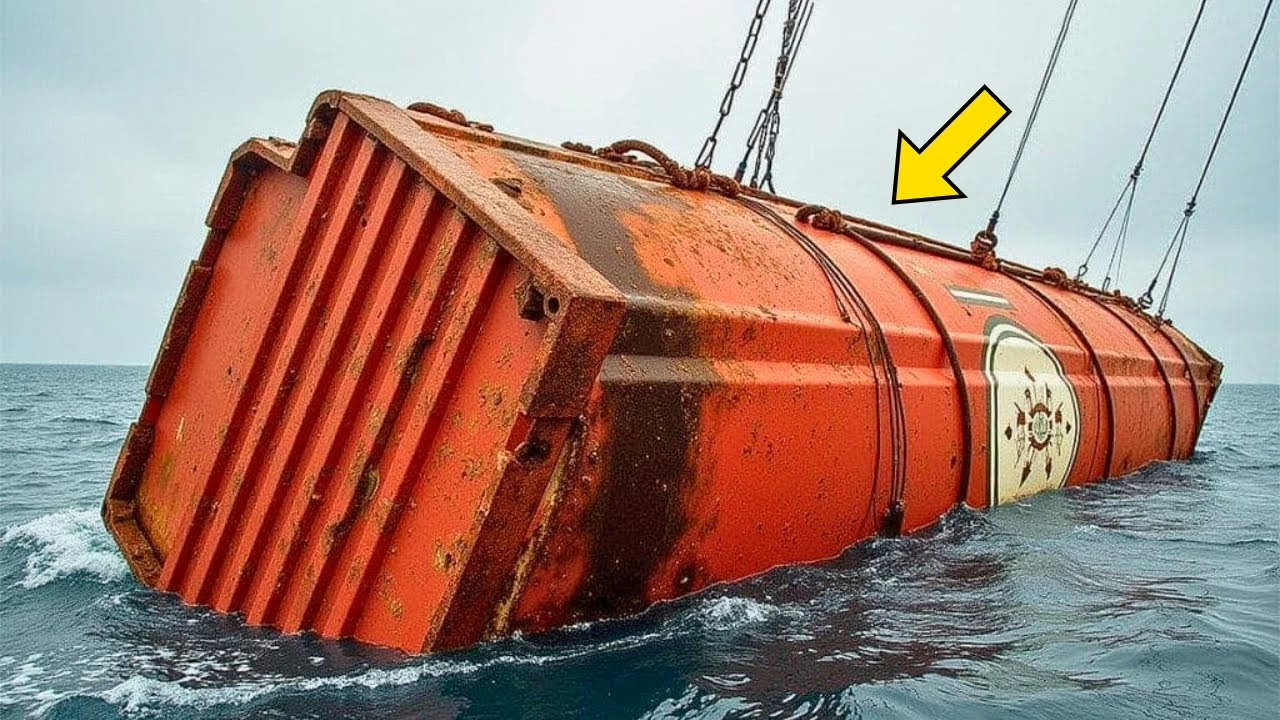
The robotic arms latched onto the container carefully, avoiding further structural damage. Slowly, inch by inch, the container was lifted from the ocean floor. As it broke the surface, seawater poured from its seams.
The metal groaned under the strain.
Crew members watched in silence as the container was secured on deck.
It was massive. Heavier than expected.
And something inside shifted.
That was when several crew members turned pale.
The Moment the Doors Opened
The container was moved to a secure location on deck. The area was cleared. Protective gear was donned. Medical staff stood by.
When the heavy-duty doors were finally unlocked, no one spoke.
The hinges resisted at first, then slowly gave way.
The doors swung open.
And everyone froze.
What They Found Inside
The container wasn’t filled with goods.
It wasn’t machinery.
It wasn’t weapons.
Inside were rows of reinforced compartments, each sealed individually. Thick glass panels revealed their contents—and what lay behind them made even veteran officers take a step back.
Personal belongings.
Photographs.
Shoes.
Watches.
And identification cards.
Hundreds of them.
The air inside was cold, unnaturally so. A low hum filled the container, coming from a power source still somehow active after all this time.
This wasn’t cargo.
It was storage.
A Chilling Realization
Investigators quickly realized what they were looking at.
The container had been modified internally. Climate-controlled. Reinforced. Designed not for transport—but for preservation.
The items belonged to people.
Crew members from the EverCargo Voyager.
And possibly others.
But there were no bodies.
No remains.
Just traces.
Evidence of lives abruptly interrupted.
Theories Begin to Surface
News of the discovery spread quickly, though details were tightly controlled.
Some speculated human trafficking. Others suggested an illegal research operation. There were even whispers of something far darker—experiments conducted far from prying eyes.
Authorities refused to speculate publicly.
But behind closed doors, one fact disturbed everyone involved.
Someone had gone to extraordinary lengths to hide this container.
And they had nearly succeeded.
The Investigation Expands
The EverCargo Voyager was towed to port for forensic analysis. The container was transferred to a secure facility. Specialists from multiple agencies were brought in.
Every item inside was cataloged.
Every name traced.
And slowly, patterns emerged.
Disappearance reports. Unsolved cases. Maritime mysteries that had gone cold years earlier.
They were all connected.
Why the Ocean?
One investigator summed it up simply:
“The ocean erases mistakes.”
A container dropped into deep water leaves no trail. No witnesses. No easy recovery.
Unless someone stumbles upon it.
Unless technology advances.
Unless luck intervenes.
The Crew Who Spoke Up
The researchers who first discovered the container were later interviewed.
They admitted something they hadn’t mentioned at first.
Their robot had detected faint electrical signals coming from the container.
Something inside had still been running.
Years later.
Official Silence
To this day, much of the case remains classified.
No arrests have been announced.
No official explanation has been released.
The Coast Guard confirmed only that the container’s contents were “under investigation” and that there was no immediate threat to public safety.
But questions remain.
Who built the container?
Who ordered its placement?
And where did the people go?
A Haunting Legacy
The EverCargo Voyager now sits in impound, stripped of its mystery but heavy with unanswered questions.
The ocean floor where the container once rested has been marked and restricted.
And those involved in the recovery say they will never forget the moment the doors opened.
Because some discoveries don’t just shock you.
They stay with you.
They follow you.
And they remind you that the sea doesn’t just hide treasure.
Sometimes, it hides truths we aren’t ready to face.
One thought on “Coast Guard Pulls Up Container From Ocean Floor, What They Found Inside Left Them Speechless”
Leave a Reply
Related Posts



Waste of time.