
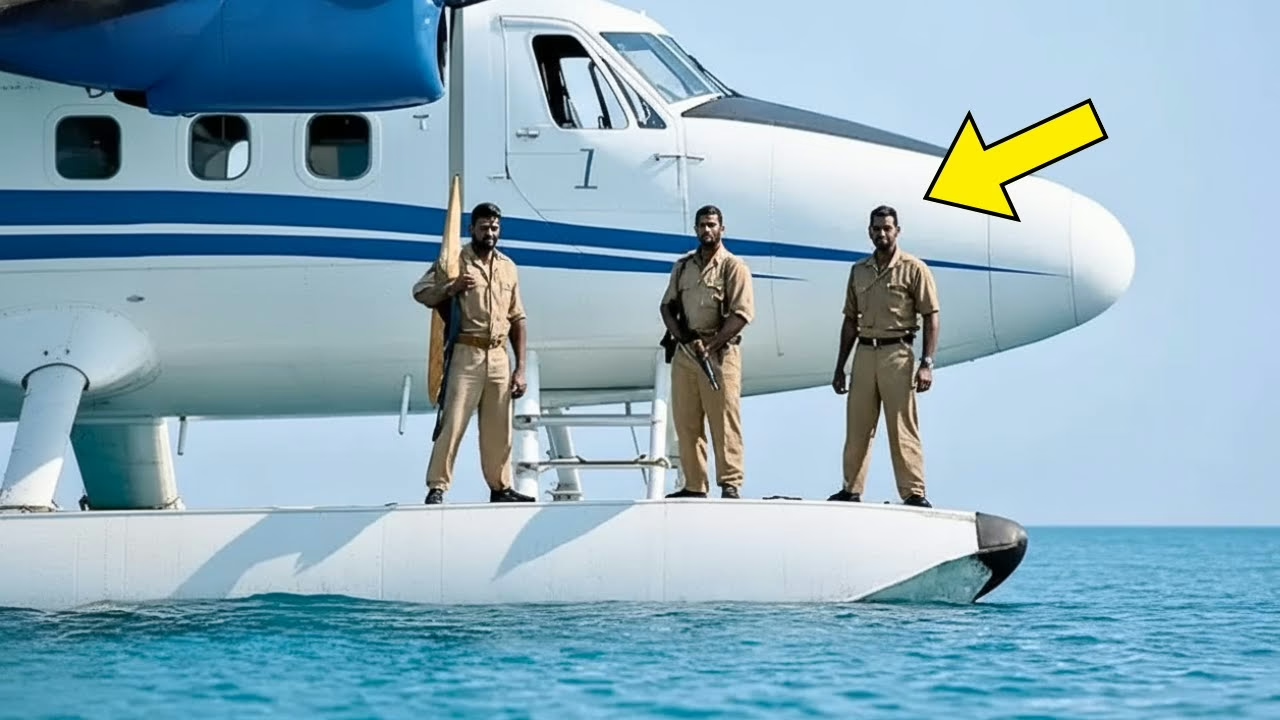
The sea plane rocked gently on the open water, its pontoons rising and falling with the slow, rhythmic breath of the Indian Ocean. The engines hummed low, not enough to propel them forward with purpose, just enough to keep the aircraft from drifting entirely at the mercy of the waves.
Captain Noah Reyes stared out at the horizon, eyes fixed on a thin, wavering line where sky met sea. A faint breeze slipped through the cockpit vents, carrying the sharp tang of salt and fuel. Sweat cooled on the back of his neck, not from heat, but from instinct.
Something wasn’t right.
Two dark shapes had appeared in the distance—long, narrow silhouettes slicing across the water with unnatural speed. They didn’t bob like fishing boats or patrol craft. They cut through the waves with intent.
Noah’s gut tightened.
“They’re not supposed to be there,” he muttered.
Beside him, co-pilot Jaime Malik leaned forward, shielding his eyes from the glare. His grin from moments earlier—celebrating flight number one hundred—was gone. His face hardened as the shapes grew clearer.
The boats came on without signal.
Without flags.
Without response.
No radio call answered their hails. Only speed. Only silence.
Whatever was coming, Noah knew one thing for certain.
It wasn’t help.
A Morning That Began Like Any Other
Just hours earlier, the day had felt almost perfect.
The early sun painted the Indian Ocean in silvers and golds, scattering light across rippling water that looked more like polished glass than open sea. Noah adjusted his headset and glanced down at the reflection of the sea plane’s wings shimmering beneath them.
To his right, Jaime tapped the altimeter with a satisfied grin.
“Flight number one hundred,” he said. “About damn time.”
Noah smiled faintly. By the end of the day, after landing in Djibouti, Jaime would qualify for International Captaincy. It was a promotion long overdue, earned through thousands of hours in the air and countless landings in conditions most pilots never faced.
They’d flown together for over a year, carrying scientists, medical teams, engineers, and fragile equipment up and down the African coastline. Dusty desert airstrips. Isolated islands. Remote coastal outposts that barely existed on maps.
Today’s manifest was light.
Three sealed crates, strapped tight in the hold. International markings. Government seals. Stamped CONFIDENTIAL.
The paperwork was vague, but Noah didn’t need details to understand the value. Satellite components, most likely. Rare. Expensive. Irreplaceable.
Still, it felt like a routine crossing—the kind that lulled even seasoned pilots into a sense of ease.
Clear skies. Calm water. No storms on radar.
Nothing to suggest how wrong the day would go.
The First Warning
The red light blinked on the panel without ceremony.
Both men noticed it at the same instant.
Noah’s hand froze mid-adjustment. Jaime leaned closer to the instruments, eyes scanning rapidly.
“Rudder actuator,” Jaime said quietly.
Noah pressed the pedals.
Nothing.
No resistance. No feedback. Just dead weight beneath his feet.
The manual override flickered once, twice—then went dark.
The rudder was gone.
A chill settled over the cockpit, sharp and immediate. Without rudder control, the aircraft was dangerously limited. Even a slight crosswind on a runway could spin them into catastrophe.
Noah didn’t panic. Panic wasted time.
“We’re not landing on a strip,” he said. “We take it to water.”
Jaime nodded, already reaching for the microphone.
“Mayday, Mayday,” he transmitted, voice steady despite the tension coiling in his chest. Coordinates followed. Situation explained. Assistance requested.
They both knew the truth before the Coast Guard confirmed it.
Help was coming—but it was hours away.
Ditching the Aircraft
The descent demanded precision bordering on obsession.
Noah adjusted the flaps, hands moving with controlled calm. The ocean spread beneath them, deceptively smooth, its glassy surface hiding the violence of the swells below.
Jaime gripped the edge of his seat, jaw clenched as the altimeter ticked down.
“Steady… steady…”
The pontoons struck hard.
For one terrifying moment, the aircraft bounced—once, twice—before the floats dug into the water. A massive wall of spray exploded upward, slamming against the cockpit windows. The entire fuselage shuddered like it had been punched by something enormous.
Then silence.
They were alive.
The sea plane bobbed in place, pitching gently as waves nudged it off course. Noah’s hands stayed locked on the yoke, knuckles pale. Jaime exhaled slowly and checked the radio.
“Coast Guard confirms,” he said. “Nearest cutter is three hours out.”
Three hours.
The aircraft drifted east under idle power, its hull creaking with each swell. The sea plane wasn’t built to drift. Not for long.
Water would find a way in eventually.
A Second Problem Emerges
Inside the cabin, the quiet felt heavy.
Jaime adjusted the GPS, calculating drift and current. Outside, swells slapped at the pontoons with growing insistence. The hull groaned, metal protesting against the pressure.
Then Noah leaned forward.
His eyes narrowed.
“Jaime… three o’clock.”
Jaime turned, shading his eyes from the sun.
Two black specks cut through the shimmer of the sea.
They weren’t Coast Guard.
They were moving too fast.
Through binoculars, their shapes sharpened—long, narrow hulls riding low and aggressive. Men stood upright, braced against the wind. No insignia. No response to radio calls.
The realization settled like a weight in the cockpit.
The emergency had changed.
From Breakdown to Pursuit
Noah eased the throttles forward, coaxing the crippled sea plane into motion. It lurched, dragging itself across the swells like a wounded animal.
Spray burst against the floats as the aircraft gathered speed.
Eight knots.
Maybe.
Behind them, the boats doubled that without effort.
Engines growled. White water fanned out behind their bows.
“They’re coming straight for us,” Jaime said quietly.
The sealed crates rattled in their harnesses with each wave impact. Neither pilot spoke it aloud, but the thought lingered between them.
If the pursuers believed something valuable was onboard, that belief alone was enough.
Desperate Preparations
The Coast Guard was still more than an hour away.
If the boats reached them first, there would be no negotiation.
Inside the aircraft, urgency took over.
Jaime moved fast, dragging crates and toolboxes across the cabin floor. Doors were barricaded with cargo nets and straps. Heavy cases wedged tight against access points.
The rear hatch had a manual locking bar—not designed for force. Jaime kicked a crate into place and cinched the netting tight, teeth clenched as the plane shuddered beneath him.
In the cockpit, Noah locked the door and wedged a fire extinguisher behind it.
Not much.
But better than nothing.
Outside, the boats closed the distance relentlessly.
The Boarding
The first impact came without warning.
The fuselage rattled violently. Then another jolt.
Jaime pressed against the barricaded door, heart hammering. Through the small window, a shadow shifted—a hand slapped flat against the glass.
No words.
Just intent.
Metal groaned.
A lock snapped.
The cockpit door burst open and three men surged inside, dripping seawater, faces hidden behind scarves. Orders were barked in a language Noah didn’t understand.
Ropes snapped tight around their wrists.
Outside, more men swarmed the floats, heading straight for the cargo.
Then chaos.
Jaime stumbled backward, tripping over the co-pilot chair and crashing into the center console. Noah’s elbow slammed into the throttle—and into a red switch labeled OXYGEN EMERGENCY.
A siren screamed through the aircraft.
Every head turned.
Salvation on the Horizon
The sound cut through the air like a blade.
Then, beyond it—
Horns.
Searchlights.
A white cutter surged over the horizon, blue stripe blazing against the sea.
The Coast Guard.
Commands thundered in multiple languages. Smaller vessels flanked the pirates. Weapons were lowered. Chaos dissolved into order within minutes.
Ropes were cut.
Noah and Jaime were pulled free, wrapped in blankets, steadied on deck.
The sealed crates were recovered intact.
The pirates were cuffed and taken into custody.
Aftermath
The sea plane drifted under the stars, battered but afloat.
Exhaustion settled deep into Noah’s bones as he watched the horizon darken. Jaime sat beside him, silent, staring at nothing in particular.
Flight number one hundred was over.
It hadn’t ended in Djibouti.
It hadn’t ended on a runway.
But it had ended with survival.
And sometimes, at sea, that is the only victory that matters.
Related Posts