Imagine a planet where the ground beneath your feet sparkles like a jewel box, where vast landscapes may be made not of rock or sand, but of diamonds. It sounds like science fiction, yet astronomers believe such a world may actually exist. Known as 55 Cancri e, this exotic exoplanet has captured global attention for one extraordinary reason: it is thought to have a diamond-rich surface.
While scientists are still uncovering the full truth, the idea of a “diamond planet” has transformed how we think about planetary formation and the sheer diversity of worlds beyond our solar system.
What is 55 Cancri e?
55 Cancri e is an exoplanet, meaning a planet that orbits a star outside our solar system. It lies about 40 light-years away from Earth in the constellation Cancer and orbits a sun-like star called 55 Cancri.
What makes this planet especially intriguing is its size and location. It is classified as a super-Earth, meaning it is larger and more massive than our planet but smaller than gas giants like Neptune. The planet is also incredibly close to its host star, completing one full orbit in just 18 hours.
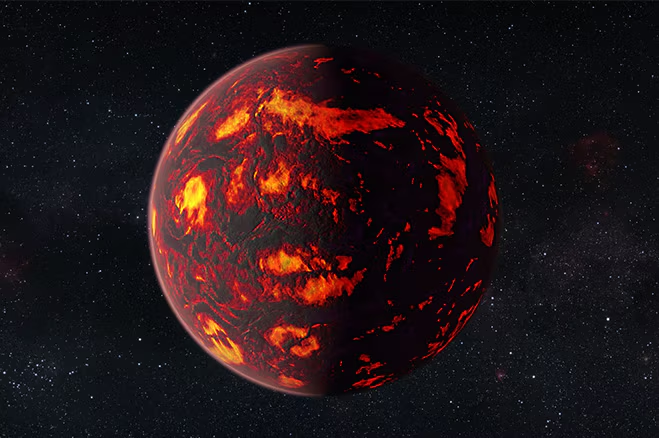
This proximity exposes 55 Cancri e to extreme heat, with surface temperatures estimated to exceed 2,000 degrees Celsius—hot enough to melt metals and vaporize rock.
Why Scientists Think It’s Made of Diamonds
The idea that 55 Cancri e could be rich in diamonds comes from studies of its chemical composition. Early research suggested that the planet formed in a star system with a high carbon-to-oxygen ratio.
On Earth, oxygen dominates, forming silicates and metal oxides. But in a carbon-rich environment, planetary building blocks can look very different. Instead of silicate rock, planets may form with:
- Carbon compounds
- Graphite layers
- Diamond structures deep within the crust and mantle
Scientists theorize that intense pressure inside 55 Cancri e could have transformed carbon into diamond, potentially creating a thick, glittering layer beneath its surface—or even across it.
A Surface Like No Other
If 55 Cancri e truly is diamond-rich, its surface would be unlike anything we can imagine on Earth. Instead of continents shaped by water and erosion, this planet may feature:
- Vast diamond plains
- Lava oceans of molten carbon
- Graphite and carbide rock formations
Recent observations suggest the planet may even have a thin atmosphere composed of vaporized rock elements such as sodium, potassium, and silicon. In such extreme heat, the boundary between solid ground and atmosphere may blur entirely.
This world would not be shiny and beautiful in the traditional sense—it would be hostile, volatile, and utterly unlivable.
How Astronomers Study a Planet So Far Away
Since no spacecraft can travel to 55 Cancri e, scientists rely on indirect methods to study it. One of the most important techniques is the transit method, where astronomers observe small dips in a star’s brightness as a planet passes in front of it.
By analyzing how starlight filters through the planet’s atmosphere, scientists can identify chemical signatures that hint at surface composition. Infrared observations have also helped estimate surface temperature and possible geological activity.
While newer data have refined earlier conclusions, the diamond-planet theory remains one of the most fascinating possibilities in modern astronomy.
Could We Ever Mine a Diamond Planet?
The idea of mining a planet made of diamonds sounds like a billionaire’s dream, but in reality, it’s completely impractical.
First, the planet’s extreme temperature would destroy any known technology. Second, traveling 40 light-years would take tens of thousands of years using current spacecraft. Finally, diamonds are only valuable because they are rare on Earth—if they were abundant, their value would collapse instantly.
Still, the concept sparks imagination and highlights how different cosmic economics would be beyond our planet.
What 55 Cancri e Teaches Us About the Universe
Whether or not the surface of 55 Cancri e is truly diamond-covered, its existence has already changed planetary science. It proves that planets form in ways far more diverse than once believed.
This exoplanet challenges Earth-centric assumptions and shows that:
- Not all rocky planets resemble Earth
- Chemistry shapes worlds in radical ways
- Planetary systems can produce outcomes beyond imagination
Each new discovery like this expands our understanding of what planets can be—and what they cannot.
Final Thoughts
A planet made mostly of diamonds sounds like fantasy, but 55 Cancri e reminds us that the universe is far stranger than fiction. While we may never walk across its glittering surface, the idea that such a world exists pushes the boundaries of science and curiosity.
In a universe filled with trillions of planets, some may be oceans of lava, others frozen wastelands—and a few, perhaps, dazzling worlds of diamond. 55 Cancri e stands as a brilliant example of how much there is still left to discover.
Related Posts