
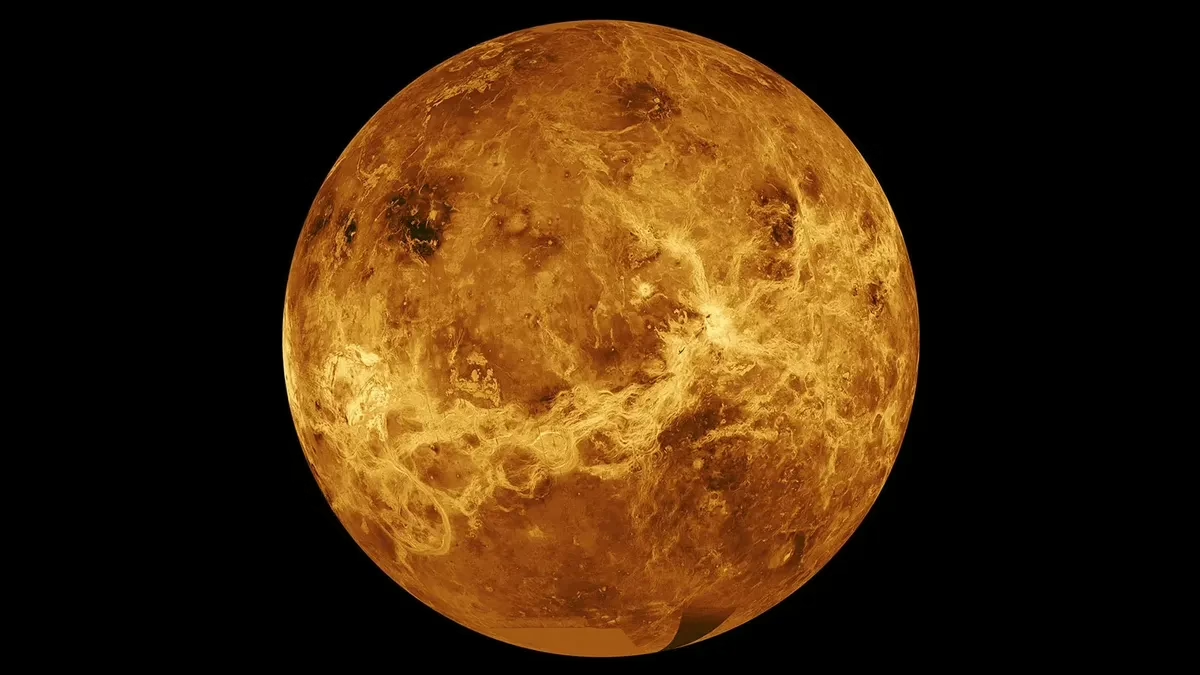
Venus has a reputation as Earth’s mysterious twin. It’s nearly the same size, made of similar materials, and relatively close to our planet. But when it comes to time, Venus completely breaks the rules. A single day on Venus is longer than an entire year on Venus, making it one of the strangest timekeeping facts in our solar system.
This bizarre reality is the result of Venus’s extremely slow rotation and offers a fascinating glimpse into how different planets can be—even when they look similar at first glance.
Understanding “Day” and “Year” on a Planet
To grasp how this is possible, it helps to understand what scientists mean by a day and a year.
- A day is the time a planet takes to rotate once on its axis.
- A year is the time it takes a planet to complete one orbit around the Sun.
On Earth, one day lasts 24 hours, and one year lasts about 365 days. That makes intuitive sense. But on Venus, these two measurements are wildly out of balance.
How Long Is a Day on Venus?
Venus rotates incredibly slowly. One full rotation on its axis takes about 243 Earth days. That means if you were standing on Venus, it would take more than eight months for the Sun to rise, cross the sky, and set again.
This rotation is so slow that Venus spins slower than any other planet in the solar system. Even more strangely, it rotates in the opposite direction to most planets, including Earth. On Venus, the Sun rises in the west and sets in the east.
How Long Is a Year on Venus?
While Venus rotates at a crawl, it orbits the Sun relatively quickly. One Venusian year lasts about 225 Earth days—shorter than its own day.
So by the numbers:
- One day on Venus: 243 Earth days
- One year on Venus: 225 Earth days
This means Venus completes a full trip around the Sun before it finishes a single rotation on its axis.
Why Does Venus Rotate So Slowly?
Scientists are still unraveling the exact reasons behind Venus’s sluggish spin, but several theories exist.
One possibility is that Venus experienced massive collisions early in its history, disrupting its rotation. Another leading idea involves gravitational interactions between Venus and the Sun. Over billions of years, the Sun’s gravity may have gradually slowed the planet’s spin.
Venus’s thick atmosphere also plays a role. The planet’s dense clouds create powerful atmospheric tides that interact with solar gravity, further affecting its rotation. Together, these factors may have contributed to Venus becoming the slow spinner we observe today.
A Day–Night Cycle Like No Other
Because Venus rotates so slowly, its day–night cycle is extreme. Each side of the planet spends months in continuous daylight followed by months of darkness.
However, Venus’s surface temperature remains astonishingly consistent. Day or night, the planet stays scorching hot—around 465 degrees Celsius (869 degrees Fahrenheit). This is due to a runaway greenhouse effect caused by its thick carbon dioxide atmosphere, which traps heat efficiently.
Unlike Earth, Venus doesn’t cool down at night. Time moves slowly there, but heat never escapes.
What Would Time Feel Like on Venus?
If humans could survive on Venus’s surface—which they cannot—it would feel utterly alien. A single sunrise would be a once-in-a-lifetime event. Shadows would crawl across the ground almost imperceptibly. Days and nights wouldn’t mark time the way they do on Earth.
Instead of counting hours, life would likely revolve around managing temperature and seeking shelter from the relentless heat. On Venus, time loses its familiar rhythm.
Why This Matters for Planetary Science
The strange relationship between Venus’s day and year helps scientists better understand planetary evolution. By studying Venus, researchers gain insights into:
- How planetary rotations change over time
- The effects of atmosphere–gravity interactions
- Why similar planets can end up dramatically different
Venus also serves as a cautionary tale. Once possibly more Earth-like, it evolved into a hostile world, reminding scientists how delicate planetary balance can be.
Venus vs. Earth: A Tale of Two Worlds
Despite being called Earth’s twin, Venus shows how small differences can lead to extreme outcomes. Earth’s moderate rotation gives us predictable days and nights, stable climates, and life-supporting conditions.
Venus, with its slow spin and dense atmosphere, became a furnace where time stretches and the Sun barely moves across the sky. Same neighborhood, completely different fate.
Final Thoughts
The fact that one day on Venus is longer than one year on Venus is more than a curious statistic—it’s a powerful reminder that the universe doesn’t follow human expectations. Time, motion, and even the Sun behave differently depending on where you stand.
Venus challenges our understanding of planetary physics and shows that even familiar-looking worlds can be profoundly strange. In the vast story of the solar system, Venus stands as a planet where time seems to slow.
Related Posts