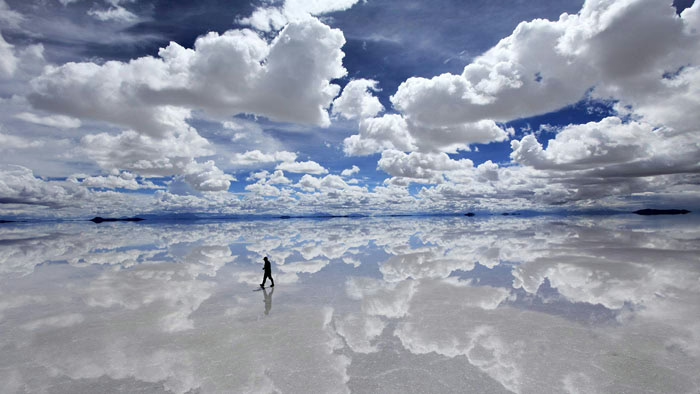
In southwest Bolivia lies a place so breathtaking it looks digitally edited—even when it’s not. The Salar de Uyuni, the world’s largest salt flat, transforms into a massive natural mirror after rainfall, reflecting the sky so perfectly that the horizon disappears.
When conditions are right, it becomes one of the most surreal landscapes on Earth.
What Is the Salar de Uyuni?
The Salar de Uyuni covers more than 10,000 square kilometers, making it the largest salt flat on Earth. It formed thousands of years ago when ancient lakes dried up, leaving behind a thick crust of salt stretching endlessly in every direction.
For most of the year, it appears as a vast white desert of hexagonal salt patterns. But when rain falls, something extraordinary happens.
How the World’s Largest Mirror Forms
After rainfall, a thin layer of water—just a few centimeters deep—spreads evenly across the salt flat. Because the surface is incredibly flat, the water acts like a perfect reflective sheet.
The result:
- The sky reflects flawlessly on the ground
- Clouds appear beneath your feet
- The horizon seems to vanish entirely
It creates the illusion of floating in the sky, with no clear boundary between Earth and heaven.
Why Salar de Uyuni Is So Perfectly Flat
Salar de Uyuni is one of the flattest places on Earth, with height variations of less than one meter across its entire surface. This extreme flatness is why the mirror effect works so well.
Scientists even use the salt flat to calibrate satellites, because its uniform surface provides incredibly accurate reference data.
A Photographer’s Dream
The mirror effect has made Salar de Uyuni world-famous among photographers and travelers. During the rainy season, people use the reflective surface to create mind-bending optical illusions—tiny figures standing on giant hands, people walking on clouds, or objects floating in midair.
No editing is needed. Nature does all the work.
More Than Just Beauty
Beyond its visual magic, Salar de Uyuni holds immense scientific and economic importance. Beneath its salt crust lies one of the world’s largest reserves of lithium, a key element used in batteries for electric vehicles and electronics.
This has made the region strategically important in discussions about renewable energy and sustainable technology.
Life in a Harsh Environment
Despite its extreme conditions, life exists around the salt flat. Nearby communities rely on salt harvesting, tourism, and small-scale agriculture. Flamingos also visit the region, adding splashes of pink against the endless white landscape.
Best Time to See the Mirror Effect
The mirror effect typically appears during the rainy season, when shallow water covers the salt flat. During the dry season, the area transforms into a geometric salt desert, offering a completely different—but equally stunning—experience.
Final Thoughts
The Salar de Uyuni feels less like a place on Earth and more like a doorway to another world. When rain turns it into the largest mirror on the planet, it challenges perception and blurs reality.
It’s proof that some of the most unbelievable sights on Earth are not illusions, tricks, or dreams—they’re real, waiting quietly under the open sky of Bolivia.
Related Posts