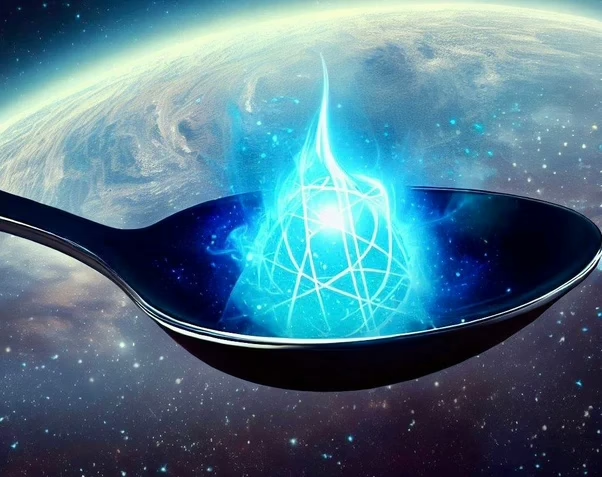
Imagine holding a teaspoon in your hand. Now imagine that same spoon weighing about a billion tons—as much as a mountain, or millions of fully loaded trucks stacked together. As impossible as it sounds, this is not science fiction. According to physicists, a teaspoon of material from a neutron star would weigh roughly a billion tons on Earth.
This astonishing fact reveals just how extreme and mysterious neutron stars truly are. They are among the densest objects in the universe, pushing matter to limits that defy everyday understanding.
What Is a Neutron Star?
A neutron star is the collapsed core of a massive star that has ended its life in a supernova explosion. When a star much larger than our Sun runs out of fuel, gravity takes over, crushing the core inward with unimaginable force.
If the remaining core isn’t massive enough to become a black hole, it collapses into a neutron star. The result is an object that:
- Is only about 20 kilometers (12 miles) wide
- Contains more mass than the Sun
- Spins incredibly fast, sometimes hundreds of times per second
Despite their small size, neutron stars pack enormous mass into an incredibly tiny volume.
Why Neutron Star Matter Is So Heavy
The secret behind the incredible weight of neutron star material lies in its density.
On Earth, atoms are mostly empty space. Electrons orbit a tiny nucleus, leaving vast gaps between particles. But inside a neutron star, gravity is so intense that atoms are crushed together. Electrons are forced into protons, forming neutrons—hence the name neutron star.
The result is matter packed so tightly that:
- A sugar-cube-sized amount would weigh billions of tons
- One teaspoon could outweigh Mount Everest
- Atomic structure, as we know, it no longer exists
This is matter in its most extreme known form, second only to black holes.
How Dense Is “A Billion Tons”?
To put this into perspective:
- The Great Pyramid of Giza weighs about 6 million tons
- All humans on Earth combined weigh roughly 400 million tons
- A modern aircraft carrier weighs about 100,000 tons
A single teaspoon of neutron star material would outweigh all of these—combined.
This density means neutron stars have incredibly strong gravity. Standing on one (if survival were possible) would subject your body to gravitational forces billions of times stronger than Earth’s.
What Would Happen If Neutron Star Matter Came to Earth?
In reality, neutron star material cannot exist freely on Earth. The intense pressure that holds it together only exists within the star itself.
If a teaspoon of neutron star matter somehow appeared on Earth:
- It would instantly decompress
- Explode violently
- Possibly punch through the planet before disintegrating
The material would no longer be stable once removed from the star’s gravity, making it impossible to store, transport, or study directly.
How Scientists Study Neutron Stars Without Touching Them
Since neutron stars are far beyond our reach, scientists rely on indirect observations. One of the most important tools is the study of pulsars, neutron stars that emit beams of radiation as they spin.
By measuring:
- Spin rates
- Gravitational effects on nearby objects
- X-ray and gamma-ray emissions
Researchers can estimate mass, radius, and internal structure. These observations help physicists test theories about matter under extreme conditions—conditions that cannot be recreated in Earth-based laboratories.
Neutron Stars and the Laws of Physics
Neutron stars act as natural laboratories for physics. They allow scientists to study:
- Nuclear forces at extreme densities
- The behavior of matter beyond atomic limits
- The boundaries between known physics and theoretical models
Some neutron stars may even contain more exotic forms of matter, such as quark matter or superfluid cores. These possibilities push the edge of what modern science can explain.
Why This Matters Beyond Curiosity
Understanding neutron stars isn’t just about awe—it has real scientific value. Insights gained from these objects influence:
- Gravitational wave research
- Supernova modeling
- The study of black holes
- Fundamental particle physics
When two neutron stars collide, they produce gravitational waves and forge heavy elements like gold and platinum, seeding the universe with materials essential to planets—and even life.
Final Thoughts
The idea that a teaspoon of neutron star material could weigh a billion tons challenges our intuition and stretches the imagination. It reminds us that the universe operates under conditions far beyond everyday experience.
Neutron stars are small, silent, and distant—but they carry within them some of the most extreme physics known to science. In their crushing gravity, matter itself is transformed, showing us just how strange and powerful the cosmos can be.
Related Posts